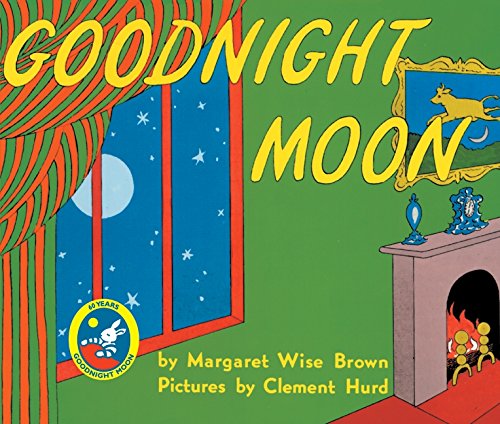
Module 1 Good Night Moon by Margaret Wise
Book Summary:
Good Night Moon is a story written by Margaret Wise Brown and illustrated by Clement Hurd. For years it has been a classic children’s bedtime story about a rabbit’s nightly routine before he goes to bed. During the story, the rabbit goes around analyzing items with his eyes before he shuts them before going to bed. Some of the things that he notices are items such as a red balloon, clock and a picture of a cow jumping over the moon. Throughout the story, the rabbit continues to say, “good night” to each item in his room until he gets very tired then finally falls asleep.
APA Reference of Book :
Brown, M. (1947). Good Night Moon. New York, NY: Harper & Collins.
Impressions:
This book is one that will remain on my classic’s list of children books. It is a classic that has been told since 1947. I was introduced to Good Night Moon as a child in grade school. I believe that this is one book that each parent should have on their self for early beginner readers. The core element in this book is that it introduces easy household items to children so they can become familiar with as the child progressively grows older. This book also makes a great read for a bedtime story for any young child. This fictional picture book narrates with illustrations that explain a story that brakes through design with vibrant colors and simple images that are appealing to the reader. Finally, the content of the book prepares words and dialogue that are short and easy the book is a calming read for any time of the hour.
Professional Review:
“Before going to sleep, a little rabbit says goodnight to all his familiar possessions as his big, green bedroom slowly darkens. Tucked away in bed, the little bunny says, “goodnight room, goodnight moon.” And to all the familiar things in the softly lit room- to the picture of the three little bears sitting in chairs, to the clocks and his socks, to the mittens and the kittens, to everything one by one the little bunny says good night. In this classic of modern children’s literature, beloved by generations of readers and listeners, the quiet poetry of the words and the gentle, lulling illustrations combine to make a perfect book for the end of the day.”
Source:
Scholastic. (2017). Good night moon. Retrieved from https://www.scholastic.com/teachers/books/goodnight-moon-by-margaret-wise-brown/
Usage in a Library Setting:
This book could be used in the library setting in the children’s section. This book would probably be categorized as “E” for easy read which means that it is a book that is appropriate children in entering early childhood grade level. As a librarian, you can introduce lesson plans, worksheets, coloring, music, and activities as a part of learning tool to enhance students understanding about the book Good Night Moon.
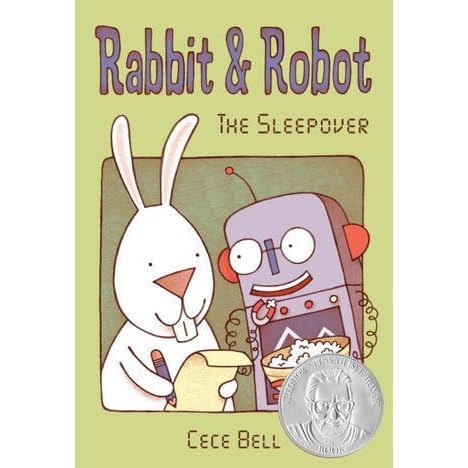
Module 2 Rabbit and Robot: The Sleepover by Cece Bell
Summary:
Rabbit & Robot is a book written by Cece Bell published in 2012. Rabbit is an anxiety prone animal who over reacts all the time about different situations when they don’t go his way. One-day Robot his best friend came to spend the night. The robot is cool and easy-going friend who helps Rabbit to calm and mellow his emotions during difficult moments. One-night Rabbit Invites Robot over for a sleep over. Rabbit plans a list of things for them to do during his stay. Rabbit is determined to complete every task in order. Each task that they do there is something that is bound to go wrong. Every time something bad happens Rabbit gets upset. The robot can keep a calm during every situation that happens and continues to encourage Rabbit to look on the bright side. At the end of the story, the two friends were unable to complete everything they had plan but Robot ensures Rabbit that today was still a good day.
Impressions:
This was an enjoyable read. It reminds me of stories about having a good friendship with someone who is willing to encourage a friend in need. There are many different elements that set a good learning aspect in reading this book. It teaches students about when situations become difficult they can always depend on a friend when times get tough. Some important aspects on friendships are
1.Feeling good about having a great mentor.
2.Doing entertaining things together.
3.Hanging out.
4.Learning.
5.Discussing good topics.
6.Sharing.
7.Fun.
8.Helping others.
The most final and important aspect is shown in friendship is love. When love is shown between two friends it is impossible to tear it apart.
APA Reference of Book :
Bell, Cece. (2014). Rabbit and Robot: The Sleepover. St. Louis, MO: Turtleback Books.
Professional Review:
“Meet the newest odd couple in the early reader section: fussy, compulsive Rabbit and overly logical Robot. The book’s four chapters, written almost entirely in dialogue, correspond to the plan for the friends’ eagerly anticipated sleepover: make pizza, watch TV, play Go Fish, go to bed. But it’s a list Rabbit generated without consulting his friend, so negotiations—delicate and otherwise—are the order of the day. The uni-wheeled, iPhone–shaped Robot wants to play Old Maid in addition to Go Fish; Rabbit insists it’s “not on the list.” Robot doesn’t like the veggies that Rabbit offers as pizza toppings, and insists on taking apart Rabbit’s furniture to get his favorite topping, nuts and bolts. But while Rabbit’s hair-trigger temper and Robot’s Vulcan mien seem like a recipe for disaster, each strong personality is willing to bend just enough—and even indulge in some comic self-reflection. Bell’s (Itty Bitty) crisp, cheery cartooning adds visual punctuation and elaboration in all the right places, and she handles moments of both calamity and reconciliation with aplomb. Delightful. Ages 5–8. Agent: Caryn Wiseman, Andrea Brown Literary Agency.”
Source
Publishers Weekly. (2017). Rabbit and robot: the sleepover.
Retrieved from https://www.publishersweekly.com/978-0-7636-5475-7
Usage in a Library Setting :
Rabbit & Robot is a short fictional book that is a part of a short series. It is a goofy and cheerful chapter book that is perfect for readers in grades K-3rd. Since the creation of this book series libraries has shown a great number of results of check outs among its readers. This book series is a very intriguing read that will have your child asking to read every book.
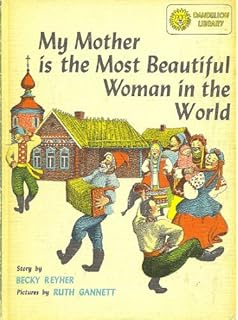
Module 3 My Mother is the Most Beautiful Women in the World by Becky Reyher, Illustrated by Ruth Gannett.
Summary :
My Mother is the Most Beautiful Woman in the World is a book by Becky Rehyer and Ruth Gannett published in 1945. It is based in the country of Russia during Harvest time. One-day Varya, a little Russian peasant girl goes traveling in the country fields with her mother. Every day her mother worked as a wheat collector while her daughter played happily in the tall plants in the field. One day her mother worked so hard in the field she fell into a deep sleep for many hours. Varya could not find her anywhere she felt afraid and lost. Varaya went into the village asking the farm workers for help finding her mother. One of the village farmers asked her what her mother looked like and she answered proudly with ambition saying, “My mother is the most beautiful woman in the world.” Eventually, her mother woke up from her deep sleep and Varya could find her long lost mother.
Impression:
My mother enlightens me every day that love conquers much more than beauty. Yes, it is true to know that beauty is appealing to the eye. But it is not the most important aspect in the world. One thing that inspired me to read this book was based upon the front cover. The cover illustration reminded me of Patricia Polacco books. It turns out that this book was written by a different author Becky Rehyer. Both books show similar elements that show written and visual entities This book shows that the love between a mother and daughter is the best love that will ever love a child could ever have.
APA Reference of Book :
Reyher, R. H., & Gannett, R. C. (1945). My mother is the most beautiful woman in the world: A Russian folktale. Boston: Lothrop, Lee & Shepard.
Professional Review:
“This is nice. An original folk tale retold from childhood memory set against a wheat field of Russia and the people in and around it. A little girl loses her mother and in explaining whose little girl she is, reiterates, "My mother is the most beautiful woman in the world". One gets a feeling of friendly comradeship, a glimpse of Russian festival celebration, a picture of a corner of life among the simple country people.” (Kirkus, 2017).
Source :
Kirkus. (2017). Kirkus review of my mother is the most beautiful woman in the world. Retrieved from https://www.kirkusreviews.com/book-reviews/becky-reyher/my-mother-is-the-most-beautiful-woman-in-the-wo/
Usage in the Library:
If you decide to take your child to the library, you can have adventure day at the library. This story is an amazing read for a mother can read to her daughter during a trip to the library. It will teach a lesson that a child’s love for her mother is forever. This book is a classic that can be found on the shelves of many libraries.
Module 4 Frindle Andrew Clements

Summary:
Frindle was written by Andrew Clements in 1996. It is about a young boy who is both annoying and inspiring as a 5th grader. He does not play by anyone's rules, not even his teacher Mrs. Granger. Nick is full of exciting ideas like calling a pen a Frindle. Soon after this starts a world win among the students and community. Mrs. Granger tries the encourage her students to learn new words to increase their vocabulary but Nick being a mischief is determined to discover incorrect new words.
Mrs. Granger is no match for Nicks new discovery. Eventually, Nicks new trend goes viral around the world.
My Impressions:
This is my favorite picks because it is short and entertaining. Something else that makes this story interesting is the wish- fulfillment premise. If a normal, ordinary child can make such marvelous things happen with creating a word into a trend, well then, why couldn’t anyone else? Frindle is a classic original book that is enjoyable and quirky tale about creative thoughts and how the usage of the power of words.
APA Reference of Book :
Clements, A., & Selznick, B. (2014). Frindle. St. Louis, MO: Turtleback Books.
Professional Review:
“Always one step ahead of his teachers, Nick not only can "feel a homework assignment coming the way a farmer can feel a rainstorm"" but can dream up a distraction to prevent the assignment from being given. In fifth grade, however, he meets his match in tough language-arts teacher Mrs. Granger. Just to get under her skin--and despite her loud protests--he invents the word "frindle"" and convinces the whole school to use it instead of the word ""pen."" The word spreads to the city, nation and world, and Clements (Big Al) fast-forwards the story by 10 years to show that “frindle"" has made it into the dictionary. With this coup Nick gets a big surprise: the proof that Mrs. Granger was rooting for "frindle"" all along. Like the Velveteen Rabbit, his well-worn word has become real. Dictionary lovers will cotton to this mild classroom fantasy, while readers who have a hard time believing that one person could invent a word out of thin air will be surprised to learn that the word ""quiz"" was invented the same way.” Ages 8-12. (Sept.).
Source:
Publishers Weekly. (2017). Frindle. Retrieved from https://www.publishersweekly.com/978-0-689-80669-8
Usage in the Library:
Frindle is a very useful book that will be enjoyed in the library during story time popular read around the world. It is a great contemporary novel with simplicity. Once any age group began to read it is easy to
want to continue to read to learn the outcome of the plot. The book will form an interesting, comical,
descriptive, and educational pattern for students, parents, and teachers who chose to read this book. This book may be introduced to kindergarten, middle school, high
school and college students.
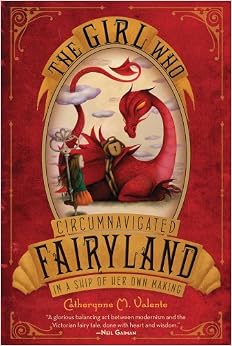
Module 5 The girl who circumnavigated fairyland by Catherynne Valente
Summary:
The Girl Who Circumnavigated Fairyland in a Ship of Her Own Making is the first book out of Catherynne M. Valente Fairyland series. This book is about a little girl named September. One day a green wind stops by and swoops by her window and invites her off to fairyland. This fairyland does not identify as cute and nice. It is unexpectedly a world filled with quirky and a bit scary.
Impression :
My first impression of this book was that I was amazed by the long title. The story is unique and contemporary plot had me exploring my expectations about how fairy tales can change story platforms. The story is written beautifully and the details are tied together in an interesting way. The best thing that I love about this book is the charterers. The characters have funny names and have interesting personalities.
APA Reference of Book :
Valente, C. M. (2013). The girl who circumnavigated Fairyland in a ship of her own making. London: Corsair.
Professional Review :
“Originally published in serialized form online (where it became the first e-book to win the Andre Norton Award for Young Adult Science Fiction and Fantasy), this glittering confection is Valente's first work for young readers. The book's appeal is crystal clear from the outset: this is a kind of The Wonderful Wizard of Oz by way of Alice's Adventures in Wonderland, made vivid by Juan's Tenniel-inflected illustrations. An omniscient narrator relates the absurd Fairyland adventures of 12-year-old September from Omaha, Neb. Valente seems more interested in crafting the individual episodes, and her narrator's moral observations thereon, then in September's overall quest to retrieve a witch's spoon from the terrible marquess of Fairyland. Homages abound—an echo of Tolkien here, a cameo by Lord Dunsany there, and a nod for Hayao Miyazaki, too, all without feeling derivative. It's an allusive playground for adults, but even though young readers won't catch every reference, those who thrill to lovingly wrought tales of fantasy and adventure (think McCaughrean or DiCamillo) will be enchanted. And though the pace is lackadaisical, it's just as well—it's the sort of book one doesn't want to end. Ages 10–14. (May)”.
Source:
Publishers Weekly. (2017). The girl who circumnavigated fairyland in a ship of her
own making. Retrieved from https://www.publishersweekly.com/978-0-312-64961-6
Usage in Library:
Valente’s writing is full of life and truths because the plot in her book is very grounded. I found the book utterly charming. It teaches children to learn how to love how the narrator’s involvement in the series is self-aware. This series is a love letter to language through representing libraries and educators.
Module 6 Strawberry Hill by Mary Ann Hoberman
Summary:
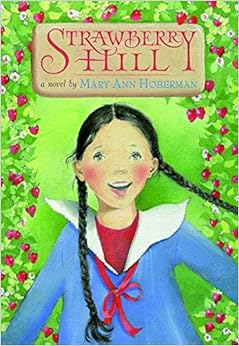
Mary Ann Hoberman wrote a book called Strawberry Hill. Strawberry Hill is about a ten-year-old Allie. Allie finds out that she will be moving into a new big family home in another town. Allie is afraid and does not want to move suddenly discoveries that she will be moving near a street with a unique name of Strawberry Hill.
Around her new home, she can search for new things such as strawberries and new friendships. By being the new kid on the block she is faced with many challenges and fitting in at her new school.
Strawberry Hill is based on Mary Hoberman’s childhood. Like every story, there is a unique adaption from a biographical life of an author. I love reading stories that are about family and friendship. Strawberry Hill was written with love and is a sweet story that was held during the Great Depression. I appreciate the real difficulties that Allie is faced with. She learns life lessons that we all go through as a child.
APA Reference of Book :
Vance, C. (1984). Strawberry Hill. London: Hodder and Stoughton.
Professional Review:
“In this old-fashioned coming-of-age story, set during the Great Depression, 10-year-old Allie's father finds a new job, and her family moves to a street called Strawberry Hill. Poet and first-time novelist Hoberman draws a full portrait of life on Strawberry Hill—where in fact there are no strawberries—as Allie agonizes over her conflicting feelings about the two other girls on her street: pretty, popular Martha, whom Allie wants as a best friend; and pudgy, sweet Mimi, who wants to be best friends with Allie. Circumstances of time and place are woven into the narrative, from details like the cost of popsicles to larger themes of poverty and prejudice. A few Allie's friends' fathers are out of work, and Martha's best friend Cynthia calls Allie a “dirty Jew” at one point (Allie notes, “I wondered why I still wanted to be best friends with someone who still wanted to be best friends with someone like Cynthia”). Allie's plight will be utterly relatable to contemporary readers and the resolution is both satisfying and realistic. Final art not seen by PW”. Ages 8–12. (July)
Source:
Publishers Weekly:
Publishers Weekly. (2017). Strawberry Hill. Retrieved from
https://www.publishersweekly.com/978-0-316-04136-2
Usage in the Library :
Strawberry Hill is an excellent story for young girls from a different era where creative imaginations drive children s interest. It reminds current readers that it is ok to take a break from electronics and get out in the fresh air to play outside.

Module 7 Week 7 All the water in the world by Ella George Lyon
Summary:
With all this water have you ever wondered where it comes from and where does it go? This book explains the daily cycle of water and how it is consumed by the earth.
Impressions:
Without water, there would be no life. Without water, human nature would not exist. The water cycle is an amazing learning element. I was amazed at how the author could place so much information about the water cycle in such a small book. All the Water in the World teaches children to appreciate and conserve our water in a good manner.
APA Reference of Book :
Loyn, G. E, and Tillotson, K. (2013). All the Water in the World. New York, N.Y:
Scholastic.
Professional Review:
Publishers Weekly
“Pattern-driven digital illustrations pair with concrete verse to express water's cyclical nature: "Thirsty air/ licks it from lakes/ sips it from ponds/ guzzles it from oceans/ and this wet air/ swirls up." In a bone-colored landscape in another part of the world, a child in a hut and wild animals in a barren tree await a gray storm cloud. When a torrent comes, a lullaby-like line assures: "Honey, / living things dream/ of water," and a mother with long, brunette hair embraces her child, droplets from her hair coalescing into tiny animal silhouettes. A lyrical and bighearted outpouring. Ages 4–8. (Mar).
Source
Publishers Weekly:
Publishers Weekly. (2017). All the water in the world. Retrieved from https://www.publishersweekly.com/978-1-4169-7130-6
Usage in the Library :
Teaching children about water education at an early age can help them understand the importance and the uses of water. Educators have many resources that they can use to teach students about this subject. Incorporating daily lessons plans with specific tips on how students may conserve water can serve as an effective teaching method during a school project.

Module 8 Week 8 American Girl Series.
Summary :
The American Girl series is based on an American girl who is an 18-inch doll that
Was released in 1986 for purchase to sell as a toy for girls around the world. The
American Girl doll is a product where girls can customize their own personal doll.
The popularity of the dolls quickly hit the market in the early 1990s and soon after the
founders decided to write a book series based upon the dolls. In the American Girl
series, there are many characters that are set during different time periods discussing
historical events. The series also entails historical mysteries that show emotion in
each book that is published. Each story challenges the character to solve a mystery in
the plot.
Impressions:
The American Girl series is a popular book series to read because the authors write
contemporary stories that girls can relate to that includes issues and events that they
are faced with each day. My favorite book series is about Addy Walker an African American girl living during the slavery time.
APA Reference of Book :
Porter, C. R., Taylor, D., Rosales, M., Graef, R., & Roberts, L. (2010). Meet Addy: An American girl, 1864. Middleton, WI: American Girl.
Professional Review:
“Addy Walker, the newest character in the American Girls Collection of dolls, accessories and books, stars in these bright historical novels. In the first, the nine-year-old girl, a slave on a North Carolina plantation during the Civil War, overhears her parents whispering about the possibility of running away. But after Addy's father and older brother are sold to another master, mother and daughter make the break alone. In a heart-rending scene, the two leave Addy's young sister, Esther, in the care of fellow slaves and begin their harrowing journey on foot to a ``safe house.'' From there they are transported by abolitionists to a ship that takes them to Philadelphia--and freedom. The second novel, lacking the dramatic tension of its predecessor but equally poignant, recounts Addy's adjustment to living free in an unfamiliar urban environment. Porter's easily flowing narrative follows Addy as she attends school for the first time and teaches about the true meaning of friendship. As in the previous American Girls novels, these two neatly balance fiction and fact, the latter quality reinforced by the concise historical notes, entitled ``A Peek into the Past,'' which conclude each volume. Rosales's emotion-charged illustrations effectively convey Addy's affability and pluck. A third installment, Addy's Surprise, is also due in September.” (Publishers Weekly, 2017). Ages 7-up. (Sept.)
Source
Publishers Weekly:
Publishers Weekly. (2017). American girl meets addy. Retrieved from https://www.publishersweekly.com/978-1-56247-075-3
Usage in the Library:
They are also quality literature because young readers can learn about transitions of
historical time periods with usage of solving mysteries. This book series is also
Age appropriate for its readers because it does not give away overwhelming story
age appropriate for its readers because it does not give away overwhelming story plots
that young reads are not able to comprehend nor plots that are too gory. That is way
the authors chose to write them in a reader friendly way.
Week 9 Module 9 Take me out of the Bathtub by Alan Katz
Summary:
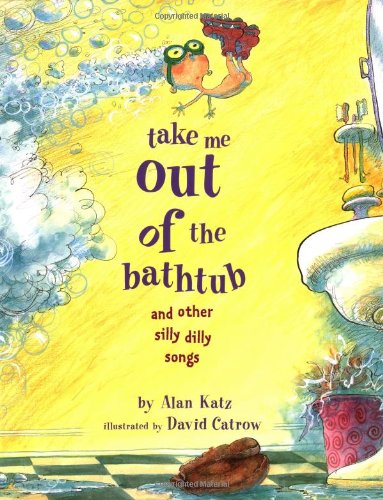
For years nursery rhymes and poetry has been adapted into many different forms and plots. In this book, Alan Katz becomes creative with using original nursery rhymes and has a quirky side to each page of the book.
Impression :
Alan Katz always seems to amaze me with his funny remarks on how clean he is supposed to be when he talks about how clean he is in his adaptations of nursery rhymes.
APA Reference:
Reference of Book :
Katz, A., & Catrow, D. (2002). Take me out of the bathtub and other silly dilly songs. New York: Scholastic.
Professional Review:
Songwriter and television comedy writer Katz provides ludicrous lyrics to 14 traditional tunes, offering playful parodies on some familiar routines. To the tune of "Take Me Out to the Ballgame," a boy wearing roller skates claims he has been soaking so long in the tub that he "used one, two, three bars of soap/ Take me out... I'm clean!" Other amusing entries include "I've Been Cleaning Up My Bedroom" (sung to "I've Been Working on the Railroad"), in which a girl tidies her room by shoving all of her belongings "out the door," which Catrow (She's Wearing a Dead Bird on Her Head!) interprets quite literally (he shows her bureau, goldfish, etc., piling up in the back yard), and "Give Me a Break" (sung to the tune of "Home on the Range"), introducing a child whose library book is long overdue. A few songs do not scan so well (e.g., this verse set to the tune of "My Bonnie Lies Over the Ocean": "My brother flicks peas with his fork and/ They zip down my shirt with a splat/ Next I see a big piece of pork land/ On my head like it's a new hat!"). But the subjects (a sibling with a stinky diaper, a youngster who refuses to go to bed, a cranky poodle think "Yankee Doodle") teamed with Catrow's outlandish illustrations, as hyperbolic as the words, will have kids giggling as they sing. Ages 2-6. (Publishers Weekly, 2017).
Source:
Publishers Weekly. (2017). Take me out of the bathtub. Retrieved from
https://www.publishersweekly.com/978-0-689-82903-1
Usage in the Library:
For 10 years this book has amazed children and adults. This book unit can be used in the library setting when choosing a contemporary book that is filled with remarkable nursery rhymes. This book is suitable for all age range.

Week 10 Module 10 Rapunzel’s Revenge by Shannon Hale
Summary:
Rapunzel’s Revenge is a graphic novel written by Shannon Hale. Rapunzel’s revenge is about a little girl with long red hair who lived the woman she thought her whole life was her mother. Everyday growing up Rapunzel played in their beautiful country garden. One day she grew curious about what was on the other side of the big garden wall. When Rapunzel grew up she began to realize that things started to seem weirder and weirder until one day she decided to climb over the wall she was horrified by what she saw beyond that point.
Impression :
This story is one of my favorite stories because it was about a girl saving herself whether a guy comes to her rescue or not. This book gives me hope to know that adventures are possible. The interesting thing about it is that the plot takes a turn by taking place in the old west.
APA Reference of Book:
Hale, D., Hale, S., & Hale, N. (2008). Rapunzel's revenge: Graphic novel. London: Bloomsbury.
Professional Review:
A beloved fairy tale gets a glossy graphic-novel makeover, reworked in a fanciful Old West setting. Rapunzel lives an idyllic life in Mother Gothel’s verdant villa until she dares question her about what lies beyond the outer wall. Her curiosity leads her to uncover the shocking truth about her past, resulting in her subsequent isolation in a faraway tower. Propelled by her strong desire to see Gothel brought to justice for her misdeeds, she escapes and embarks upon a journey to seek the truth. Along the way, she meets up with Jack (of beanstalk fame) and faces enemies of epic proportions, including sea serpents and a pack of murderous coyotes. The Hales apply a new twist (or three) to the classic tale, creating a strong, sassy, braid-whipping character who waits for no prince. Nathan Hale’s art, stylistically reminiscent of a picture book, provides a snazzy counterpoint to the folksy text. A dash of typical fairy-tale romance, a strong sense of social justice and a spunky heroine make this a standout choice for younger teens. (Graphic fiction. 10-14). (Kirkus, 2017).
Source:
Kirkus Review:
Kirkus Review. (2017). Rapunzel’s Revenge. Retrieved from
Usage in the Library:
All stories deserve a twist and Rapunzel’s Revenge gives the perfect hilarious plot to a different side of the original classic that we are used to reading. This contemporary story will have girls and boys asking to read more graphic novels like this amazing adaptation of Rapunzel’s Revenge. Graphic novels are a bit different from writing a regular novel. It is more like a written screen play. Kids will love this book because it is full of description with a fun turn.
